The Scene Everyone Argues About: Why the Most Debated Moments in Books and Movies Never Let Go
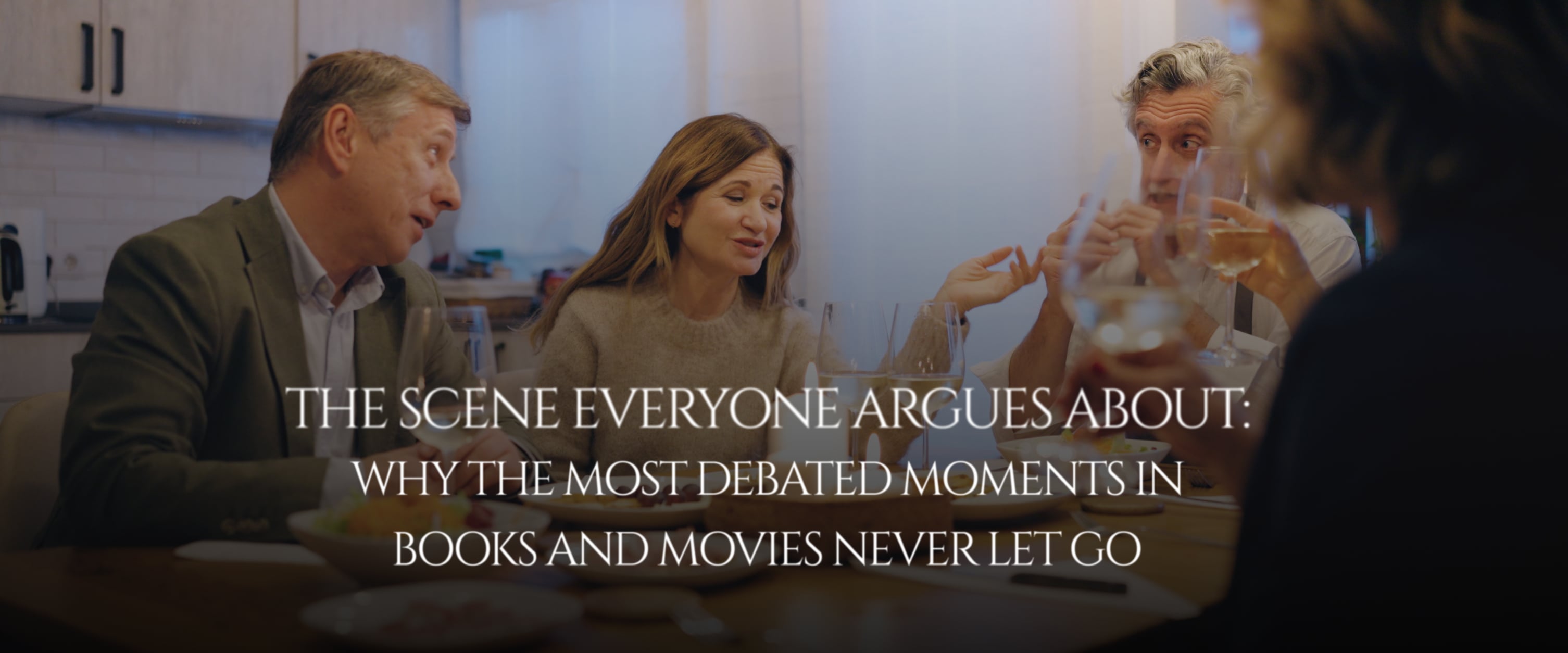
Every family has one. Somewhere between the second helping and dessert, someone mentions a movie ending, and the table splits right down the middle. Half are certain they know what happened. The other half are just as certain of the opposite. Nobody changes their mind, and somehow everyone leaves happier for having had the argument. I've sat on both sides of that table more times than I can count.
I want to talk about the scene everyone argues about: the most debated scenes in books and movies, why certain moments refuse to hand us an easy answer, and what keeps us arguing about them years, sometimes decades, later.
Here's what I've noticed. An ambiguous ending, on its own, isn't enough. A story that's simply vague doesn't start arguments. It just leaves people shrugging. The scenes that spark endless debate are the ones where the evidence points in two directions at once, and both directions matter. The writer hasn't hidden the answer. They've built two answers and balanced them so carefully that the reader has to choose. And the moment you choose, you've told everyone at the table something about yourself.
Frank Stockton understood this back in 1882. His short story The Lady, or the Tiger? ends with a young man standing before two doors in an arena, one hiding a bride and the other a hungry tiger, while the princess who loves him quietly signals which door to open. Did she send him to the woman she'd lose him to, or to the tiger? Stockton never says. More than a century later, readers are still arguing about it, and the argument was never really about the doors. It's about whether love is generous or possessive, and everyone answers from their own heart.
Film has given us some of the most argued-over endings of all. Viewers have debated for decades whether Rick Deckard in Blade Runner is human, and audiences walked out of Inception arguing about a spinning top that wobbles, keeps spinning, and then cuts to black. In Life of Pi, both Yann Martel's novel and the film that followed, Pi offers two versions of what happened on that lifeboat and then gently asks which story you prefer. What these moments share is timing. The last page, or the final frame, stops one beat before certainty. The storyteller trusts you with the rest.
And sometimes the argument is happening right now. If you’ve been anywhere near a bookstore or a movie theatre this fall, you’ve probably heard someone ask whether they’re Team Manuscript or Team Letter. Colleen Hoover’s Verity, about a struggling writer hired to finish a famous author’s book series, ends with two pieces of writing that can’t both be true, and readers have been picking sides since the novel came out in 2018. The film adaptation of the Verity movie, starring Anne Hathaway and Dakota Johnson, arrived in theatres this October and set the whole debate alight again. Even the cast has chosen teams.
Some of the most controversial book endings aren't puzzles at all. We know exactly what happened. What we can't agree on is whether it was right. A character makes an impossible choice, and readers split over whether it was mercy, betrayal, or somehow both. I think those debates last the longest, because there's no clue we've missed and no rewatch that will settle it. The disagreement lives in us.
Television has a few of these too. Decades after it first aired, Friends can still split a room with four words: “We were on a break!” Was Ross right, or was Rachel? Fans have been picking sides for thirty years, and I’m not sure anyone has ever been talked out of theirs.
As a thriller writer, I'll admit I build toward these moments on purpose. Psychological thrillers live in the space between what a character believes and what's actually true, and the best of them leave a little of that space open even after the last page. In Finding Ruby Draker, everything hinges on a name: a woman handed an identity that isn't hers by the people who took her, on a plane bound for Nice. How much of who we are is the name we're given, and how much survives when it's taken away? I have my own answer. I'm not sure it should be yours.
Reinhardt asks a similar question from the other side: can a Cold War spy truly disappear just by becoming someone else, when his enemy has eyes and ears everywhere? In Shadows in the Aftermath, Felix Szabo keeps terrorizing the Draker family even after his death, which raises the question I find most unsettling of all: when does a villain's story actually end? And in Underneath the Fireflies, Grace Walker sees the truth whether she wants to or not. I'd love to know whether you'd call that a gift or a curse, because I suspect the answer says as much about the reader as it does about Grace.
Here's a confession: the hardest part of writing a scene like this isn't the ambiguity. It's the restraint. Every instinct tells me to add one more line, one more explanation, so that no one could possibly misunderstand. But a scene that explains itself completely is a scene nobody talks about afterward. Some of the most important editing I do is cutting the sentence that would have settled the argument.
If I had to boil it all down, I'd say the scenes we argue about longest share three things. The evidence genuinely supports more than one reading. The stakes are high enough that the answer matters. And the question underneath, about love, loyalty, guilt, or who we really are, is one we're still working out in our own lives. That's why a twenty-year-old movie ending can start a brand-new argument tonight.
An ending is a door, too. The best ones are left just slightly ajar, and we keep arguing because we can still feel the draft coming through.
– Marianne